
Generative AI has become a powerful tool for businesses seeking to improve productivity and lower costs. But it might be good for more than simply drafting emails and creating presentations. As concerns around cybersecurity continue to grow, many organizations are turning to AI for help.
But is this really the best approach? How can generative AI be used in cybersecurity – and is it effective?
Do you need help protecting your business? Get expert support
What is Generative AI?
Artificial intelligence (AI) has existed in some form for decades, but the concept of generative AI is relatively new. Unlike older models, this variant leverages machine learning (ML) to not just absorb information it is given, but create new things using that knowledge. This makes it far more effective as a business tool: generative AI can draft content, reply to emails, answer questions, and provide solutions to problems. With these capabilities, it is little wonder that this useful technology has become so popular in recent years.
The Role of AI in Cybersecurity
Many businesses are already leveraging AI and ML to improve their cybersecurity. There are several ways that these technologies can help:
- Threat Detection: AI can analyze large amounts of data, recognizing patterns and detecting anomalies that may indicate a threat. This means that attacks are identified far earlier, limiting the harm they can cause.
- Incident Response: In addition to detecting an attack, many systems can enact basic response measures (such as blocking an IP address or locking down an account). This helps isolate the threat until human staff can intervene.
- Predictive Analytics: By analyzing data from past attacks, AI can forecast potential future threats before they even strike your business. Some AI systems can even proactively identify vulnerabilities that put you at risk.
24/7 Monitoring: Unlike human employees, AI does not require a salary or time off. Your systems can be monitored for danger around the clock, at a much lower cost.
What is the Use of Generative AI in Cybersecurity?
The above features are not unique to generative AI, which is more content-focused. This raises an understandable question: compared to the normal benefits of AI in cybersecurity, do generative models provide anything new? The answer, surprisingly, is yes.
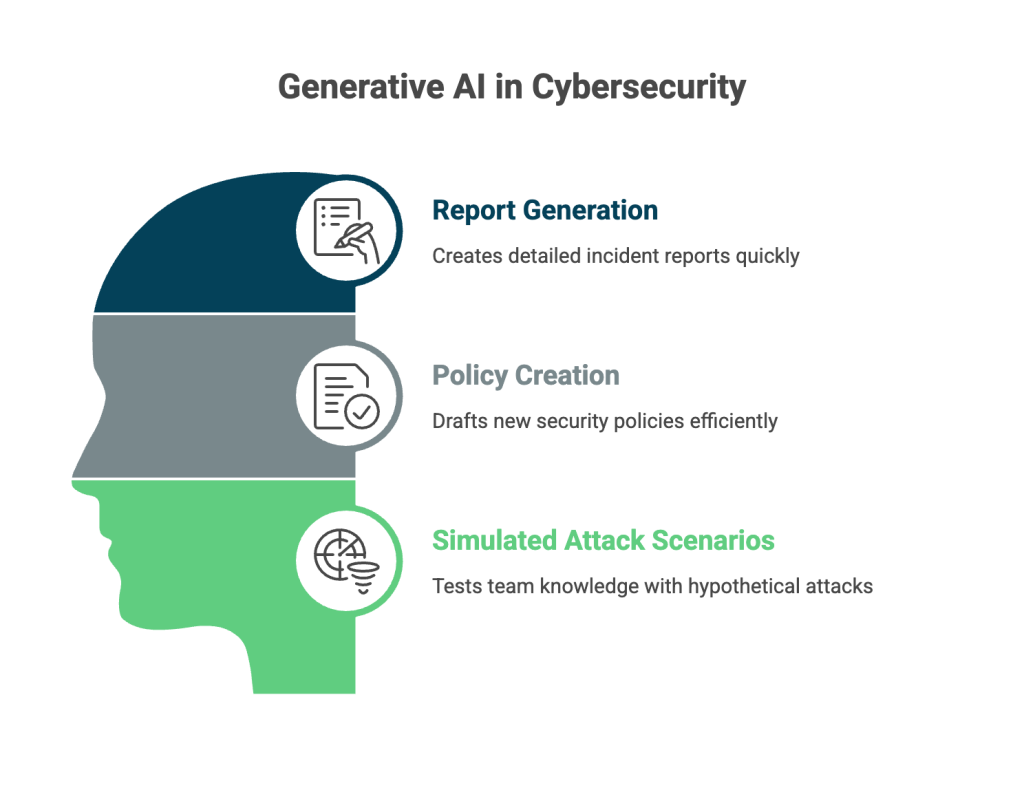
The unique advantages of generative AI in cybersecurity include:
- Report Generation: Generative AI can be used to create detailed incident reports almost instantly, allowing you to analyze them and develop a plan moving forward.
- Policy Creation: Using generative AI, you can draft new security policies faster and with fewer errors.
- Simulated Attack Scenarios: During training sessions, you can input information into generative AI and ask it to create a hypothetical attack scenario. This can then be used to test your team’s real-world knowledge.
Ethical AI in Cybersecurity: Important Considerations
Growing concerns about the ethics of AI have made it essential to implement best practices. Ask yourself these questions:
- Is AI work output being fact-checked?
- How is data being collected and stored? Does this comply with local and international regulations?
- Is the AI training on sensitive data?
- Are there any biases embedded within your AI (for instance, from previous conversations) that could affect its output?
- How are you offsetting the environmental impact of AI use?
Taking the time to ensure your business is using AI ethically is important. Not only does it ensure regulatory compliance and assist your security efforts – it also drastically improves your reputation.
The Disadvantages of AI in Cybersecurity
Unfortunately, no IT solution is perfect. Some disadvantages of AI in cybersecurity include:
- Errors: AI tools sometimes flag legitimate behavior as suspicious, or fail to detect threats. Certain generative AI models (such as ChatGPT) are known for factual errors that can impact the quality of output.
- Security Concerns: Because generative AI often trains on the data it is given, there can be concerns about privacy and security. In the worst-case scenario, AI itself can become an attack vector.
- Staff Buy-In: Employees are often unhappy with AI being introduced into the workplace, as it raises concerns that they are being replaced. This may cause them to resist its adoption.
- Knowledge Gaps: Generative AI requires an entirely new set of skills, which your IT staff may not have.
- Threat Actors Use It Too: You are not the only one using AI to improve your productivity. Threat actors have realized they too can leverage its powerful features, launching more effective attacks.
Solving these challenges, fortunately, is relatively simple. Use ethical practices and provide additional support for your staff. Explain that your intention is not to replace them, but to empower them. Finally, teach employees how to recognize the warning signs of an AI-driven cyber threat. These steps can do a lot to protect your business from the more negative impacts of AI in cybersecurity.
The Future of AI in Cybersecurity
AI technology is still developing, and change is inevitable. Some of the latest developments in cybersecurity AI that you should know about are:
- Legislation: Some countries are already beginning to legislate AI, which could have a significant impact on how businesses are allowed to use it in the future. For example, the EU has ruled that it cannot be used for biometric identification (such as facial recognition).
- Self-Healing AI: Tomorrow’s AI may be capable of automatically patching vulnerabilities and applying necessary updates, without any human intervention. This could significantly reduce the maintenance work involved.
- The Emerging Threat of Deep Fakes: As time passes, it is becoming exceedingly clear that AI-powered social engineering scams are the future. Malicious actors can now create perfect imitations of real coworkers and employers, making it impossible to detect a phishing attack through traditional means. New strategies must be developed to account for this.
Understanding the future of AI in cybersecurity is essential, so you can be prepared for these changes.
FAQs
Can AI Replace My Cybersecurity Staff?
No. While it can delay the need for additional employees by reducing workloads, it cannot replace human staff entirely. You will still need an IT team (or managed service provider) to check and act on any information it gives you.
Do I Really Need to Use Ethical AI Practices?
Yes. Ethical AI practices build trust with clients and partners, lower your risk of cyber-attacks, and improve employee morale.
How Can I Use AI More Ethically?
Only use reputable models that allow you to opt-out of data training, have human staff fact-check all output, and think about your carbon footprint. You should also disclose all use of AI to relevant parties, as this fosters trust.
What if AI Gets Legislated?
AI is already being legislated across the world. However, most of these laws focus on ensuring accountability and transparency.
Which Generative AI Model Should I Use for Cybersecurity?
This will entirely depend on your needs. Research the options available, and choose the one that best suits your business.
Expert Solutions for a Stronger, Safer Future
In the last few years, AI has become an extremely valuable cybersecurity tool for businesses trying to survive in an increasingly dangerous market. Threat detection and response, continuous monitoring, and behavioral analysis have made it a force to be reckoned with. If you use it ethically and support your staff, you can overcome the few challenges involved and ensure that AI strengthens your security, rather than weakening it.
Not sure how to get started? The cybersecurity professionals at Ascentient are here to help. We implement advanced IT solutions designed to improve your efficiency, security, and productivity. More importantly, we offer long-term support to help you resolve any issues that pop up. If that sounds interesting, get in touch with a support specialist now.