
When small and medium-sized businesses (SMBs) start scaling their IT, they must answer one important question: is it better to hire an in-house team, or should they outsource?
Each approach has its own set of benefits – and challenges – that impact its suitability for your organization. So how do you make the right decision? What is the difference between outsourcing vs in-house IT, and which should you choose?
What Does It Mean to Outsource?
A managed service provider (MSP) is a third-party team of experts who take over daily IT management tasks. This may include support, cybersecurity, monitoring, cloud management, and more. They can work alongside your existing staff, or replace the need for an internal team completely.
These days, many businesses choose the latter – using an MSP in lieu of in-house staff. The hope is that this strategy will save them time, money, and effort in the long run. But will it? Or are they falling for a clever marketing ploy?
The Real Cost of In-House IT Support
On the surface, maintaining an in-house team might feel like the cheapest option. In today’s “Do it yourself” culture, there is a belief that third-party services represent an unnecessary additional cost. However, the truth is far more complicated.
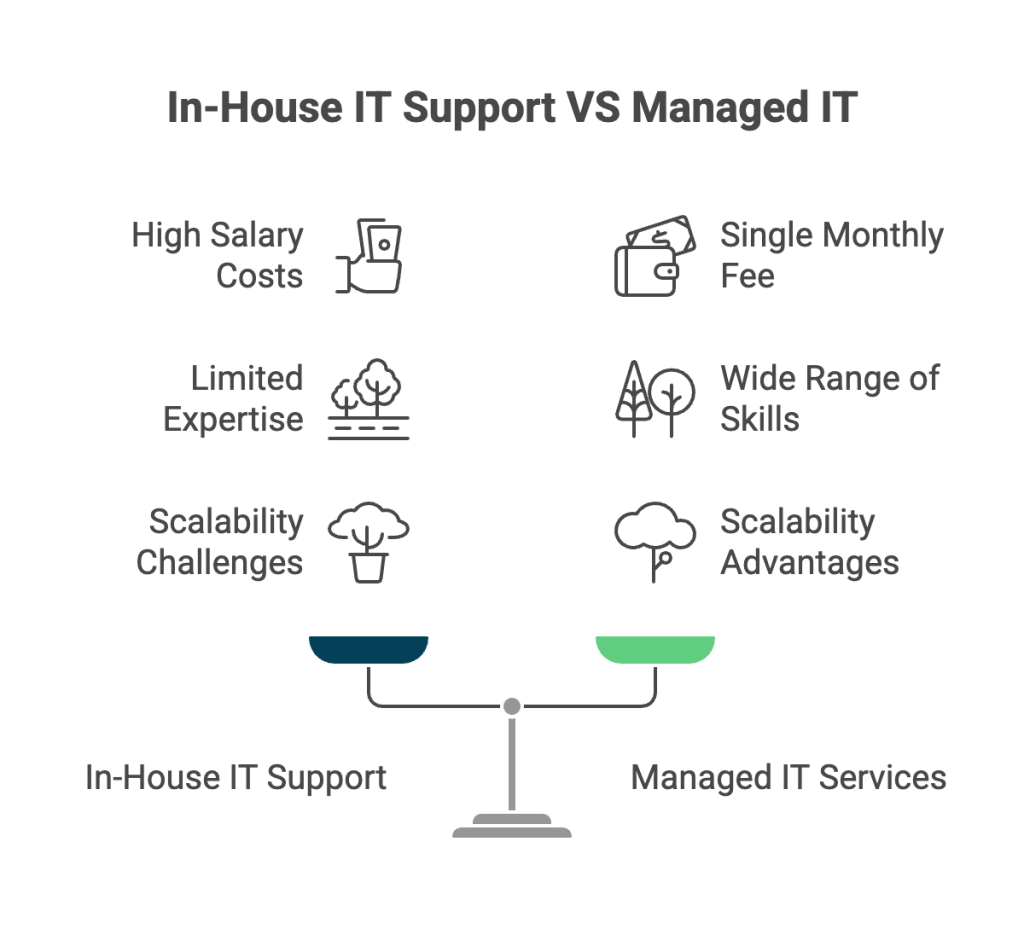
The salary for a single IT staff member, depending on their level of experience and job title, could be anywhere from $75,000 to over $125,000. Note that each additional team member added will cost a similar amount, and you do have to pay more for specialized experience. This means that, while it’s possible to keep expenses low when your business is small, any amount of growth quickly presents a problem.
That is without even mentioning the price of:
- Training
- Equipment
- Office space
- Benefits
- Security and monitoring tools
- Additional data backups
Each of these carry their own, often high, cost. The salary itself is ultimately a small fraction of the total amount you pay. And if a staff member needs to be replaced, you must go through the whole process again. This might mean your initial investment is entirely wasted, particularly if you experience seasonal demand or a high turnover.
An MSP, on the other hand, asks for only a single monthly fee. While the amount varies by a number of factors, it usually will not cost much more than one or two in-house staff. For this price, you receive access to an entire team of experts with a wide range of specialized skills – making it a significantly less expensive choice as you begin to grow. Where costs are concerned, there is no competition between in-house IT vs outsourcing.
Outsourced Services and Flexibility
Flexibility is one of the most important attributes of any business. You need the agility to respond quickly to changes within your market environment, and this can be difficult when scaling inherently requires new staff or layoffs.
Outsourcing is one of the only ways to effectively solve this problem. MSPs typically offer multiple plans that provide varying levels of support, and may even provide further flexibility within these. This makes scaling significantly easier, as you can adjust your service level (and thus, expenses) on short notice.
Issue Resolution: Who Does It Better?
Downtime can cost hundreds of even thousands of dollars per minute, causing severe damage to your business. Unfortunately, while an in-house team might feel like the solution, it often just makes things worse. Internal staff only work certain hours, and often have limited expertise, reducing their effectiveness. Issue resolution is slow and rife with errors.
One of the biggest benefits of outsourced IT, comparatively, is 24/7 support. This means faster response times, and less downtime. MSPs also typically provide customized support designed to perfectly match your business’ needs, rather than the one-size-fits-all solutions that someone with less experience might rely on.
In-House vs Outsourced IT Support: Which Should You Choose?
You may not need to choose between in-house vs outsourcing IT. If you already have staff, value their work, and don’t want to replace them, an MSP can help you boost their output without undermining them. A co-managed model is particularly good for this. However, you may not have the resources for both. In this case, carefully consider your needs.
This article may appear one-sided, and that’s for good reason. An MSP is invaluable for SMBs without the resources to maintain the in-house expertise they require. In many cases, it is the best option. However, there are some circumstances where outsourcing might be better. For example:
- You have low IT needs, and your current team can fulfill them with ease
- You do not currently have any plans for growth, or are scaling back
- Your market is stable and predictable
In these cases, outsourcing may indeed be a superfluous cost. For that reason, you need to sit down and consider your unique circumstances. Only then can you make a truly informed decision.
Find the Support Your Business Needs to Thrive
Between the cost savings, improved continuity, and higher agility, it is easy to see why so many SMBs see managed IT services as their holy grail. But before you make a decision, stop and take a breath. Take the time to truly understand your business, its needs, and the current market, and you cannot possibly go wrong.
Are you considering outsourcing? Finding the right partner can be difficult. To help you, we have compiled a list of providers in Chicago, IL that we think could be the perfect match. Discover your ideal MSP now.